Shapefunctions
The shapefunctions module contains generic shapefunctions that can be used to approximate distributed systems without giving any information about the systems themselves. This is achieved by projecting them on generic, piecewise smooth functions.
Shapefunction Types
-
class
LagrangeFirstOrder(start, top, end, **kwargs)[source]¶ Bases:
pyinduct.core.FunctionLagrangian shape functions of order 1.
Parameters: - start – start node
- top – top node, where

- end – end node
Keyword Arguments: - half –
- right_border –
- left_border –
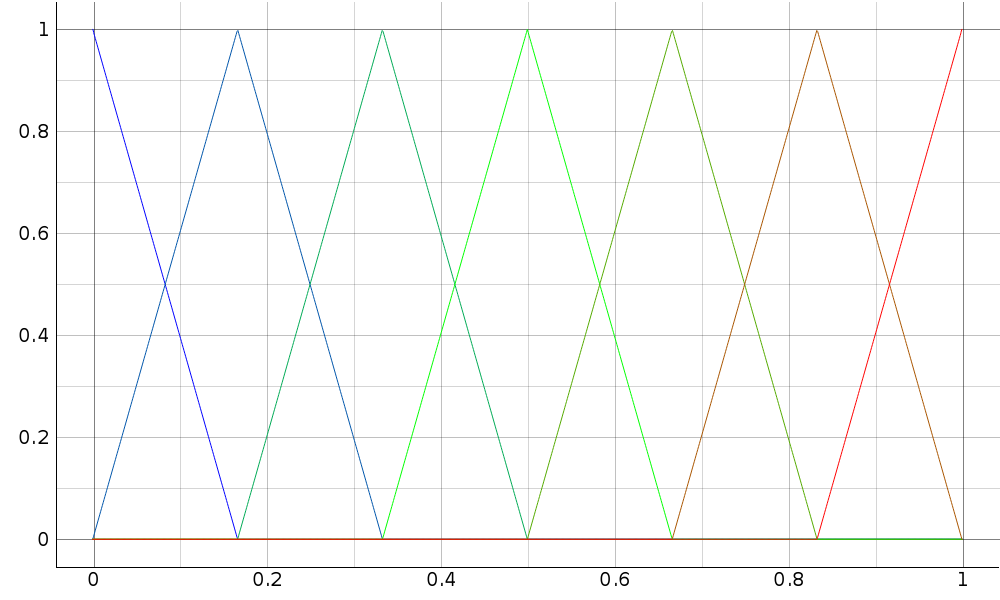
Example plot of the functions
funcsgenerated with>>> nodes, funcs = cure_interval(LagrangeFirstOrder, (0, 1), node_count=7)
-
static
cure_hint(domain, **kwargs)[source]¶ Hint function that will cure the given interval with LagrangeFirstOrder.
Parameters: domain ( pyinduct.simulation.Domain) – domain to be curedReturns: (domain, funcs), where funcs is set of LagrangeFirstOrdershapefunctions.Return type: tuple
-
class
LagrangeSecondOrder(start, mid, end, **kwargs)[source]¶ Bases:
pyinduct.core.FunctionLagrangian shape functions of order 2.
Parameters: - start – start node
- mid – middle node, where
- end – end node
Keyword Arguments: - curvature (str) – “concave” or “convex”
- half (str) – Generate only “left” or “right” half.
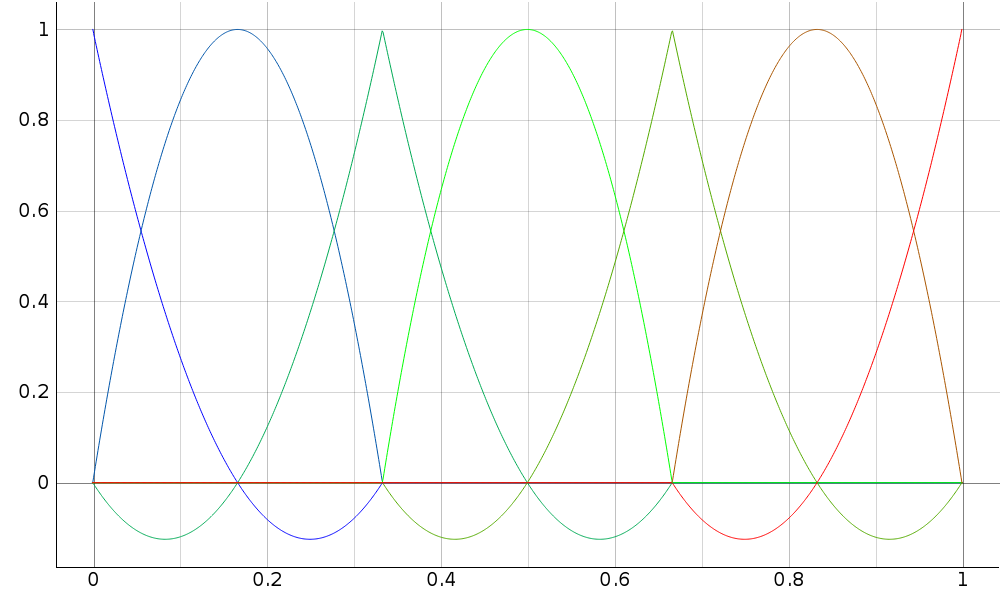
Example plot of the functions
funcsgenerated with>>> nodes, funcs = cure_interval(LagrangeSecondOrder, (0, 1), node_count=7)
-
static
cure_hint(domain, **kwargs)[source]¶ Hint function that will cure the given interval with LagrangeSecondOrder.
Parameters: domain ( pyinduct.simulation.Domain) – domain to be curedReturns: (domain, funcs), where funcs is set of LagrangeSecondOrdershapefunctions.Return type: tuple
Curing an Interval
All classes contained in this module can easily be used to cure a given interval.
For example let’s approximate the interval from  to
to  with 3
piecewise linear functions:
with 3
piecewise linear functions:
>>> nodes, funcs = cure_interval(LagrangeFirstOrder, (0, 1), node_count=3)
The approximation nodes of the functions are chosen automatically:
>>> list(nodes)
[0.0, 0.5, 1.0]
-
cure_interval(shapefunction_class, interval, node_count=None, node_distance=None, **kwargs)[source]¶ Use shape functions to cure an interval with either node_count nodes or nodes with node_distance.
Parameters: - shapefunction_class – Class to cure the interval (e.g.
LagrangeFirstOrder). The given class has to provide acure_hint(). - interval (tuple) – Limits that constrain the interval.
- node_count (int) – Amount of nodes to use.
- node_distance (numbers.Number) – Distance of nodes.
Note
Either node_count or node_node_distance can be specified. If both are given and are not consistent, an exception will be raised by
pyinduct.simulation.Domain.Raises: TypeError– If given class does not provide a staticcure_hint()method.Returns: (domain, funcs): Wheredomainis apyinduct.simulation.Domaininstance andfuncsis a list of (e.g.LagrangeFirstOrder) shapefunctions.Return type: tuple - shapefunction_class – Class to cure the interval (e.g.