Simulation

PDE Simulation Basics

...

Multiple PDE Simulation

The aim of the class CanonicalForms is to handle more than one pde. For one pde CanonicalForm would be sufficient. The simplest way to get the required N CanonicalForms‘s is to define your problem in N WeakFormulation‘s and make use of parse_weak_formulation(). The thus obtained N CanonicalForms you can pass to convert_cfs_to_state_space (in a list) to derive a state space representation of your multi pde system.

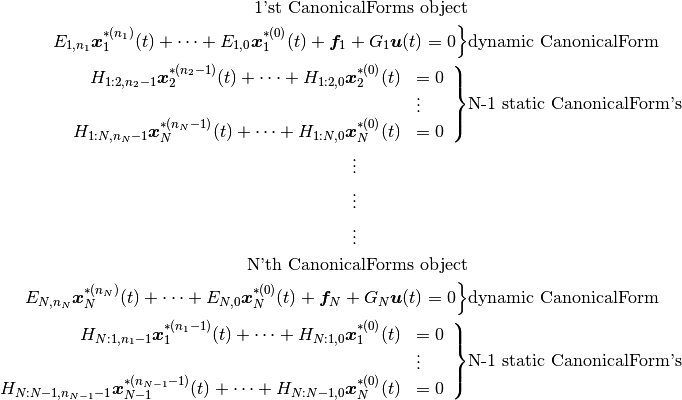
Each CanonicalForms object hold one dynamic CanonicalForm and maximum N-1 static CanonicalForm‘s.

\begin{align*}
\text{1'st CanonicalForms object} \\
\left. E_{1,n_1} \boldsymbol x_1^{*(n_1)}(t) + \cdots + E_{1,0}\boldsymbol x_1^{*(0)}(t) + \boldsymbol f_1 + G_1 \boldsymbol u(t) = 0 \right\}&\text{dynamic CanonicalForm} \\
\left.\begin{array}{rl}
    H_{1:2,n_2-1} \boldsymbol x_2^{*(n_2-1)}(t) + \cdots + H_{1:2,0}\boldsymbol x_2^{*(0)}(t) & = 0 \\
     & \vdots \\
    H_{1:N,n_N-1} \boldsymbol x_N^{*(n_N-1)}(t) + \cdots + H_{1:N,0}\boldsymbol x_N^{*(0)}(t) & = 0 \\
\end{array}\right\}&\text{N-1 static CanonicalForm's} \\
\vdots \hphantom{dddddddddddd} \\
\text{N'th CanonicalForms object} \\
\left. E_{N,n_N} \boldsymbol x_N^{*(n_N)}(t) + \cdots + E_{N,0}\boldsymbol x_N^{*(0)}(t) + \boldsymbol f_N + G_N \boldsymbol u(t) = 0 \right\}&\text{dynamic CanonicalForm} \\
\left.\begin{array}{rl}
    H_{N:1,n_1-1} \boldsymbol x_1^{*(n_1-1)}(t) + \cdots + H_{N:1,0}\boldsymbol x_1^{*(0)}(t) & = 0 \\
     & \vdots \\
    H_{N:N-1,n_{N-1}-1} \boldsymbol x_{N-1}^{*(n_{N-1}-1)}(t) + \cdots + H_{N:N-1,0}\boldsymbol x_N^{*(0)}(t) & = 0 \\
\end{array}\right\}&\text{N-1 static CanonicalForm's} \\
\end{align*}

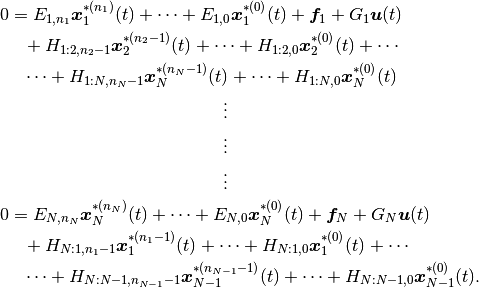
They are interpreted as

\begin{align*}
0 &= E_{1,n_1} \boldsymbol x_1^{*(n_1)}(t) + \cdots + E_{1,0}\boldsymbol x_1^{*(0)}(t) + \boldsymbol f_1 + G_1 \boldsymbol u(t) \\
&\hphantom =
    + H_{1:2,n_2-1} \boldsymbol x_2^{*(n_2-1)}(t) + \cdots + H_{1:2,0}\boldsymbol x_2^{*(0)}(t) + \cdots \\
&\hphantom =
      \cdots + H_{1:N,n_N-1} \boldsymbol x_N^{*(n_N-1)}(t) + \cdots + H_{1:N,0}\boldsymbol x_N^{*(0)}(t) \\
     & \hphantom{ddddddddddddddddddddddd}\vdots \\
     & \hphantom{ddddddddddddddddddddddd}\vdots \\
     & \hphantom{ddddddddddddddddddddddd}\vdots \\
0 &= E_{N,n_N} \boldsymbol x_N^{*(n_N)}(t) + \cdots + E_{N,0}\boldsymbol x_N^{*(0)}(t) + \boldsymbol f_N + G_N \boldsymbol u(t) \\
&\hphantom =
    + H_{N:1,n_1-1} \boldsymbol x_1^{*(n_1-1)}(t) + \cdots + H_{N:1,0}\boldsymbol x_1^{*(0)}(t) + \cdots \\
&\hphantom =
      \cdots + H_{N:N-1,n_{N-1}-1} \boldsymbol x_{N-1}^{*(n_{N-1}-1)}(t) + \cdots + H_{N:N-1,0}\boldsymbol x_{N-1}^{*(0)}(t).
\end{align*}

These N equations can simply expressed in a state space model

\dot{\boldsymbol{x}}^*(t) = A\boldsymbol{x}*(t) + B\boldsymbol{u}(t) + \boldsymbol f

with the weights vector

\boldsymbol x^{*^T} = \Big(\underbrace{0^T}_{\mathbb{R}^{\text{dim}(\boldsymbol x_1^*)(n_1-1)}}, \boldsymbol x_1^{*^T},
\quad ... \quad,
\underbrace{0^T}_{\mathbb{R}^{\text{dim}(\boldsymbol x_{N}^*)(n_{N}-1)}}, \boldsymbol x_{N}^{*^T}\Big).