R.a.d. eq. with dirichlet b.c. (fem approximation)
Simulation of the reaction-advection-diffusion equation with dirichlet boundary
condition by  and dirichlet actuation by
  .
.
![\begin{align*}
\dot{x}(z,t) = a_2x''&(z,t) + a_1x'(z,t) + a_0x(z,t) && z\in (0, l), t>0\\
x(z,0) &= x_0(z) && z\in [0,l]\\
x(0,t) &= 0 && t>0\\
x(l,t) &= u(t) && t>0
\end{align*}](../_images/math/bc65452766bfefd2a84e34fea6fc681c1ec82dbc.png)
example: heat equation

 –>
–> pyinduct.trajectory.RadTrajectory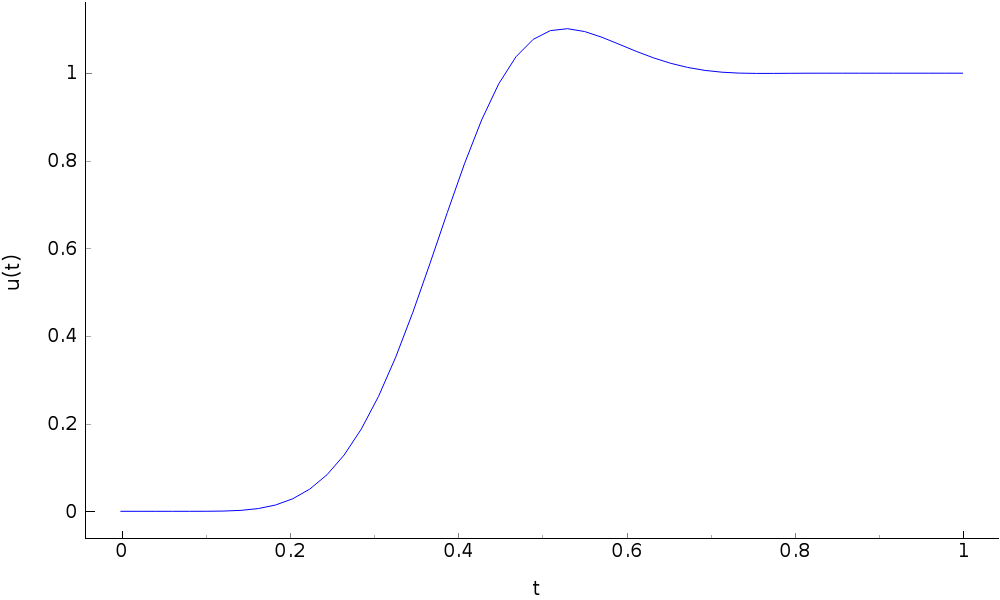

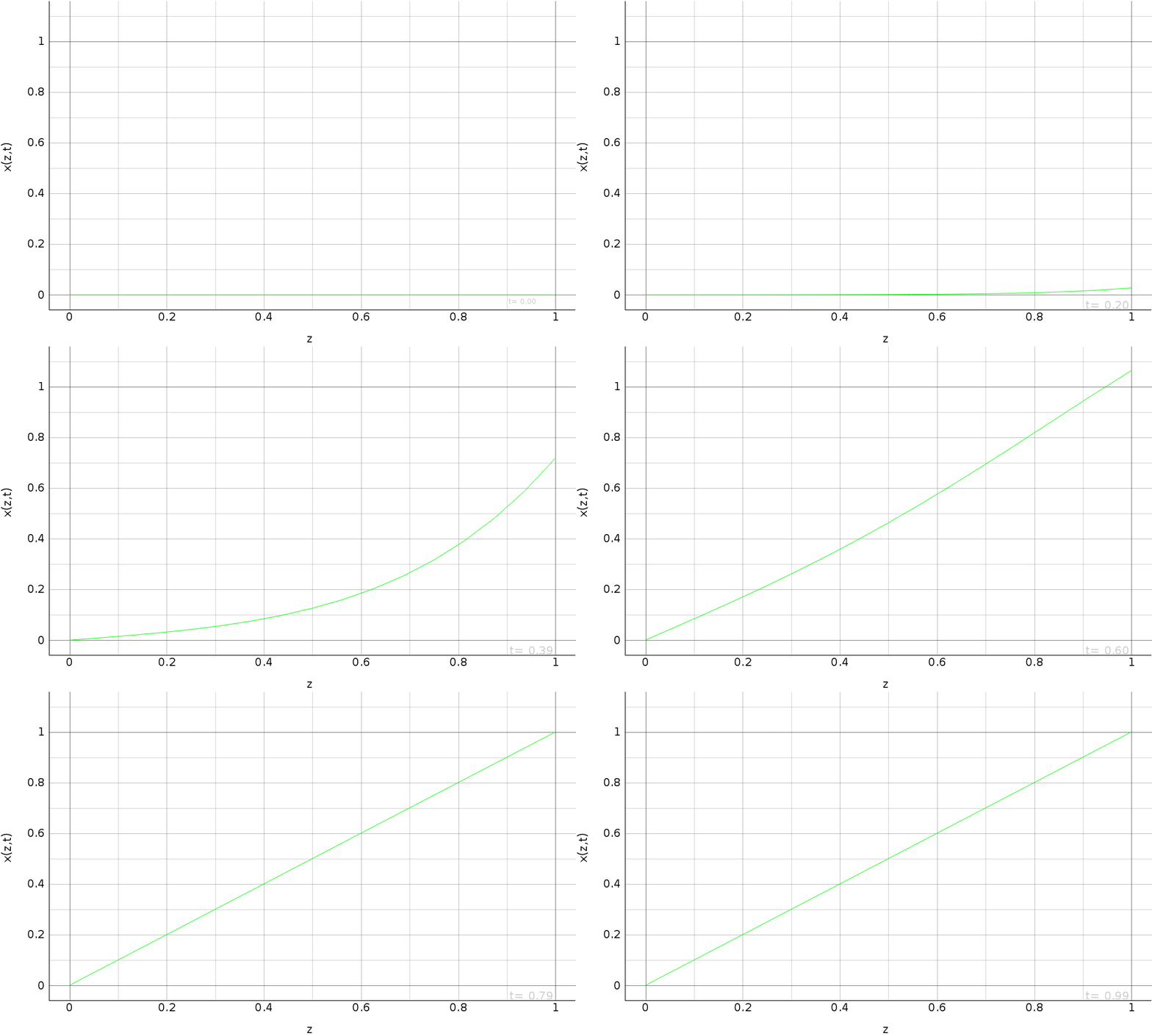

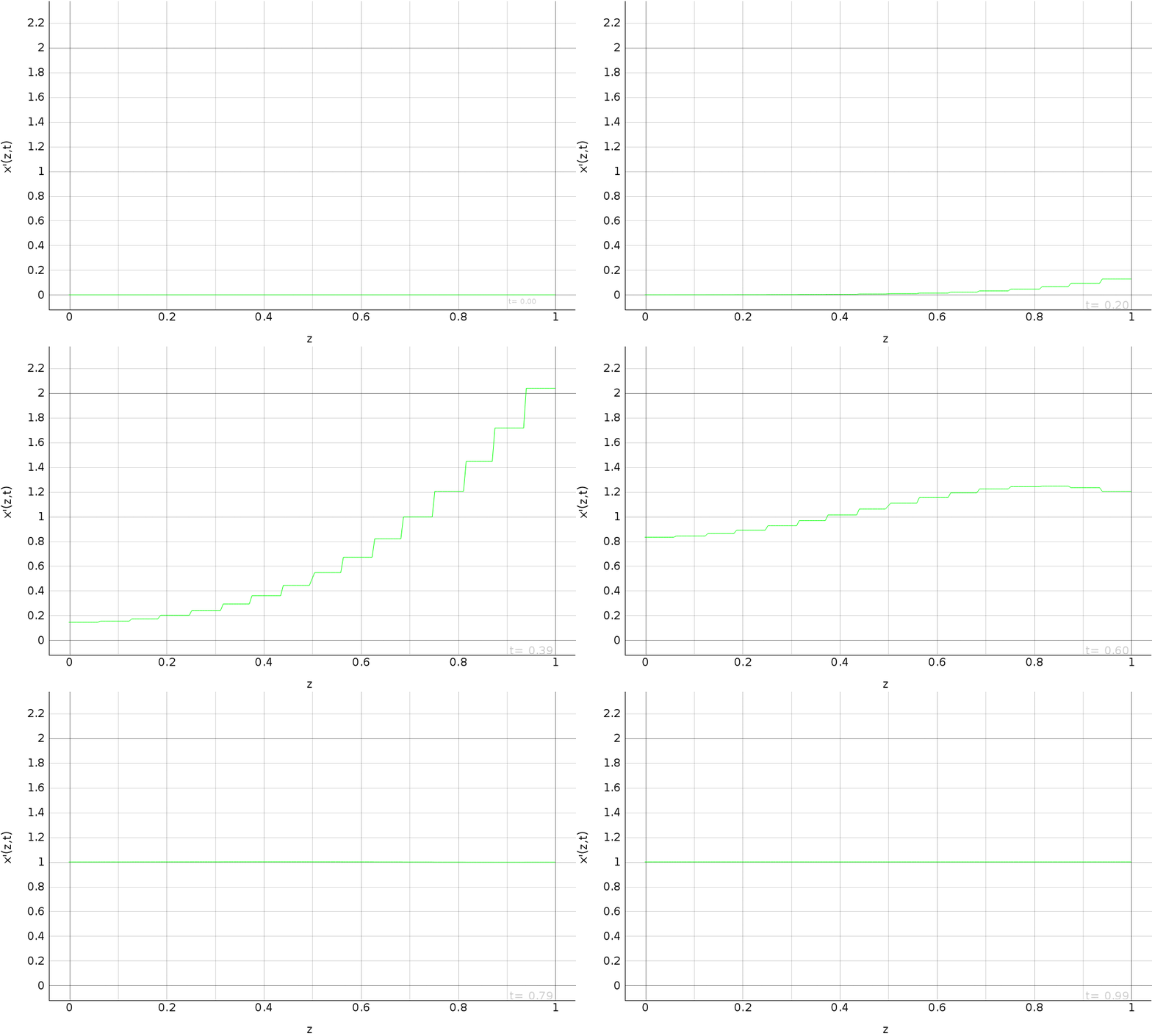
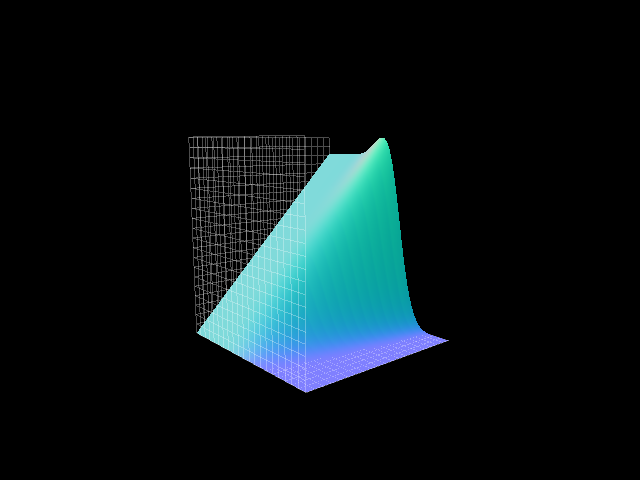
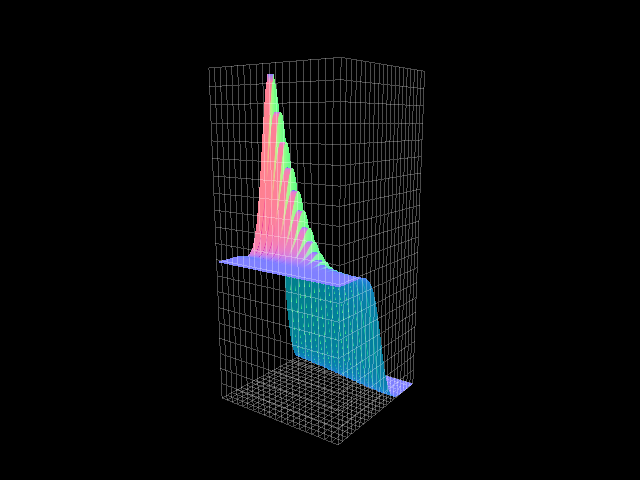
corresponding 3d plots
|
|
|
|
with:
inital functions

test functions

where the functions
 met the homogeneous b.c.
only
 can draw the actuation
functions
e.g. from type pyinduct.shapefunctions.LagrangeFirstOrderorpyinduct.shapefunctions.LagrangeSecondOrder, seepyinduct.shapefunctions
approach:

- weak formulation…

- … and derivation shift to work with lagrange 1st order initial functions
![\begin{align*}
\langle\dot{x}(z,t),\varphi_j(z)\rangle &=
\overbrace{[a_2 [x'(z,t)\varphi_j(z)]_0^l}^{=0} - a_2 \langle x'(z,t),\varphi'_j(z)\rangle \\
&\hphantom =+
a_1 \langle x'(z,t), \varphi_j(z)\rangle +
a_0 \langle x(z,t), \varphi_j(z)\rangle && j=1,...,n \\
\langle\dot{\hat{x}}(z,t),\varphi_j(z)\rangle + \langle\varphi_{N+1}(z),\varphi_j(z)\rangle \dot u(t) &= - a_2 \langle \hat x'(z,t),\varphi'_j(z)\rangle - a_2 \langle \varphi'_{N+1}(z),\varphi'_j(z)\rangle u(t) \\
&\hphantom =+
a_1 \langle \hat x'(z,t), \varphi_j(z)\rangle + a_1 \langle \varphi'_{N+1}(z), \varphi_j(z)\rangle u(t) + \\
&\hphantom =+
a_0 \langle \hat x(z,t), \varphi_j(z)\rangle + a_0 \langle \varphi_{N+1}(z), \varphi_j(z)\rangle u(t) && j=1,...,n
\end{align*}](../_images/math/7d8790f4d110cf2006a8b1c737a251029cbd8847.png)
- leads to state space model for the weights
 :
:

input derivative elimination through the transformation:


- leads to

- source code:
from pyinduct.tests import test_examples

if __name__ == "__main__" or test_examples:
    import numpy as np
    import pyinduct as pi
    import pyinduct.parabolic as parabolic

    n_fem = 17
    T = 1
    l = 1
    y0 = -1
    y1 = 4

    param = [1, 0, 0, None, None]
    # or try these:
    # param = [1, -0.5, -8, None, None]   #  :)))
    a2, a1, a0, _, _ = param

    temp_domain = pi.Domain(bounds=(0, T), num=100)
    spat_domain = pi.Domain(bounds=(0, l), num=n_fem * 11)

    # initial and test functions
    nodes = pi.Domain(spat_domain.bounds, num=n_fem)
    fem_base = pi.LagrangeFirstOrder.cure_interval(nodes)
    act_fem_base = pi.Base(fem_base[-1])
    not_act_fem_base = pi.Base(fem_base[1:-1])
    vis_fems_base = pi.Base(fem_base)

    pi.register_base("act_base", act_fem_base)
    pi.register_base("sim_base", not_act_fem_base)
    pi.register_base("vis_base", vis_fems_base)

    # trajectory
    u = parabolic.RadFeedForward(l, T,
                                 param_original=param,
                                 bound_cond_type="dirichlet",
                                 actuation_type="dirichlet",
                                 y_start=y0, y_end=y1)

    # weak form
    x = pi.FieldVariable("sim_base")
    x_dt = x.derive(temp_order=1)
    x_dz = x.derive(spat_order=1)
    phi = pi.TestFunction("sim_base")
    phi_dz = phi.derive(1)
    act_phi = pi.ScalarFunction("act_base")
    act_phi_dz = act_phi.derive(1)

    weak_form = pi.WeakFormulation([
        # ... of the homogeneous part of the system
        pi.IntegralTerm(pi.Product(x_dt, phi),
                        limits=spat_domain.bounds),
        pi.IntegralTerm(pi.Product(x_dz, phi_dz),
                        limits=spat_domain.bounds,
                        scale=a2),
        pi.IntegralTerm(pi.Product(x_dz, phi),
                        limits=spat_domain.bounds,
                        scale=-a1),
        pi.IntegralTerm(pi.Product(x, phi),
                        limits=spat_domain.bounds,
                        scale=-a0),

        # ... of the inhomogeneous part of the system
        pi.IntegralTerm(pi.Product(pi.Product(act_phi, phi),
                                   pi.Input(u, order=1)),
                        limits=spat_domain.bounds),
        pi.IntegralTerm(pi.Product(pi.Product(act_phi_dz, phi_dz),
                                   pi.Input(u)),
                        limits=spat_domain.bounds,
                        scale=a2),
        pi.IntegralTerm(pi.Product(pi.Product(act_phi_dz, phi),
                                   pi.Input(u)),
                        limits=spat_domain.bounds,
                        scale=-a1),
        pi.IntegralTerm(pi.Product(pi.Product(act_phi, phi),
                                   pi.Input(u)),
                        limits=spat_domain.bounds,
                        scale=-a0)],
        name="main_system")

    # system matrices \dot x = A x + b0 u + b1 \dot u
    cf = pi.parse_weak_formulation(weak_form)
    ss = pi.create_state_space(cf)

    a_mat = ss.A[1]
    b0 = ss.B[0][1]
    b1 = ss.B[1][1]

    # transformation into \dot \bar x = \bar A \bar x + \bar b u
    a_tilde = np.diag(np.ones(a_mat.shape[0]), 0)
    a_tilde_inv = np.linalg.inv(a_tilde)

    a_bar = (a_tilde @ a_mat) @ a_tilde_inv
    b_bar = a_tilde @ (a_mat @ b1) + b0

    # simulation
    def x0(z):
        return 0 + y0 * z

    start_func = pi.Function(x0, domain=spat_domain.bounds)
    full_start_state = np.array([pi.project_on_base(start_func,
                                               pi.get_base("vis_base")
                                               )]).flatten()
    initial_state = full_start_state[1:-1]

    start_state_bar = a_tilde @ initial_state - (b1 * u(time=0)).flatten()
    ss = pi.StateSpace(a_bar, b_bar, base_lbl="sim", input_handles=u)
    sim_temp_domain, sim_weights_bar = pi.simulate_state_space(ss,
                                                               start_state_bar,
                                                               temp_domain)

    # back-transformation
    u_vec = np.reshape(u.get_results(sim_temp_domain), (len(temp_domain), 1))
    sim_weights = sim_weights_bar @ a_tilde_inv + u_vec @ b1.T

    # visualisation
    plots = list()
    save_pics = False
    vis_weights = np.hstack((np.zeros_like(u_vec), sim_weights, u_vec))

    eval_d = pi.evaluate_approximation("vis_base",
                                       vis_weights,
                                       sim_temp_domain,
                                       spat_domain,
                                       spat_order=0)
    der_eval_d = pi.evaluate_approximation("vis_base",
                                           vis_weights,
                                           sim_temp_domain,
                                           spat_domain,
                                           spat_order=1)

    plots.append(pi.PgAnimatedPlot(eval_d,
                             labels=dict(left='x(z,t)', bottom='z'),
                             save_pics=save_pics))
    plots.append(pi.PgAnimatedPlot(der_eval_d,
                             labels=dict(left='x\'(z,t)', bottom='z'),
                             save_pics=save_pics))

    win1 = pi.PgSurfacePlot(eval_d, title="x(z,t)")
    win2 = pi.PgSurfacePlot(der_eval_d, title="x'(z,t)")

    # save pics
    if save_pics:
        path = pi.save_2d_pg_plot(u.get_plot(), 'rad_dirichlet_traj')[1]
        win1.gl_widget.grabFrameBuffer().save(path + 'rad_dirichlet_3d_x.png')
        win2.gl_widget.grabFrameBuffer().save(path + 'rad_dirichlet_3d_dx.png')
    pi.show()

    pi.tear_down(("act_base", "sim_base", "vis_base"), plots + [win1, win2])